Perform
Everyone performs in Studio Class and Percussion Ensemble. Percussion Ensemble is an essential lab experience of applied study; majors do not audition.
How the ASU percussion studio runs: when everything meets, what is expected, and what is coming up this semester.
Fall 2026. Studio Class and Percussion Ensemble meet in the Percussion Room, Room 288.
| Activity | Meeting time |
|---|---|
| Applied lessons | Scheduled individually and set for the semester |
| Studio Class | Mondays, 4:00–4:50 p.m. |
| Percussion Ensemble | Tuesdays and Thursdays, 4:00–4:50 p.m.Spring 2027: Tuesdays and Thursdays, 2:00–3:15 p.m. |
| Student recitals | Wednesdays, 4:00 p.m. Sign up on the studio door. |
| Drumline sectional | Fridays, 4:00 p.m. |
| Ram Band | Mondays, Wednesdays, and Fridays, 5:00 p.m., in the fall |
Every meeting follows the same shape, so you always know what to have ready when you walk in: a studio recital, where scheduled performers play, followed by structured peer feedback; then announcements and room reset.
Bring sticks and mallets, a pencil, and your music to every session. Performances are graded on preparation and growth, not perfection.
Recital slots rotate, but every student performs at least once in each unit: snare, mallets, timpani, and drum set or multiple percussion.
Everyone performs in Studio Class and Percussion Ensemble. Percussion Ensemble is an essential lab experience of applied study; majors do not audition.
B.M. and B.A. students practice two hours a day. Non-majors, one hour.
Bring sticks, mallets, music, a pencil, and your lesson log to every lesson. Keep a lesson notebook: assignments, technical and musical comments, goals, studio class materials, practice logs.
You have two free absences across lessons, studio class, and ensemble combined. Give notice by the night before if you cannot attend a lesson. Attend every equipment move for any ensemble you are in.
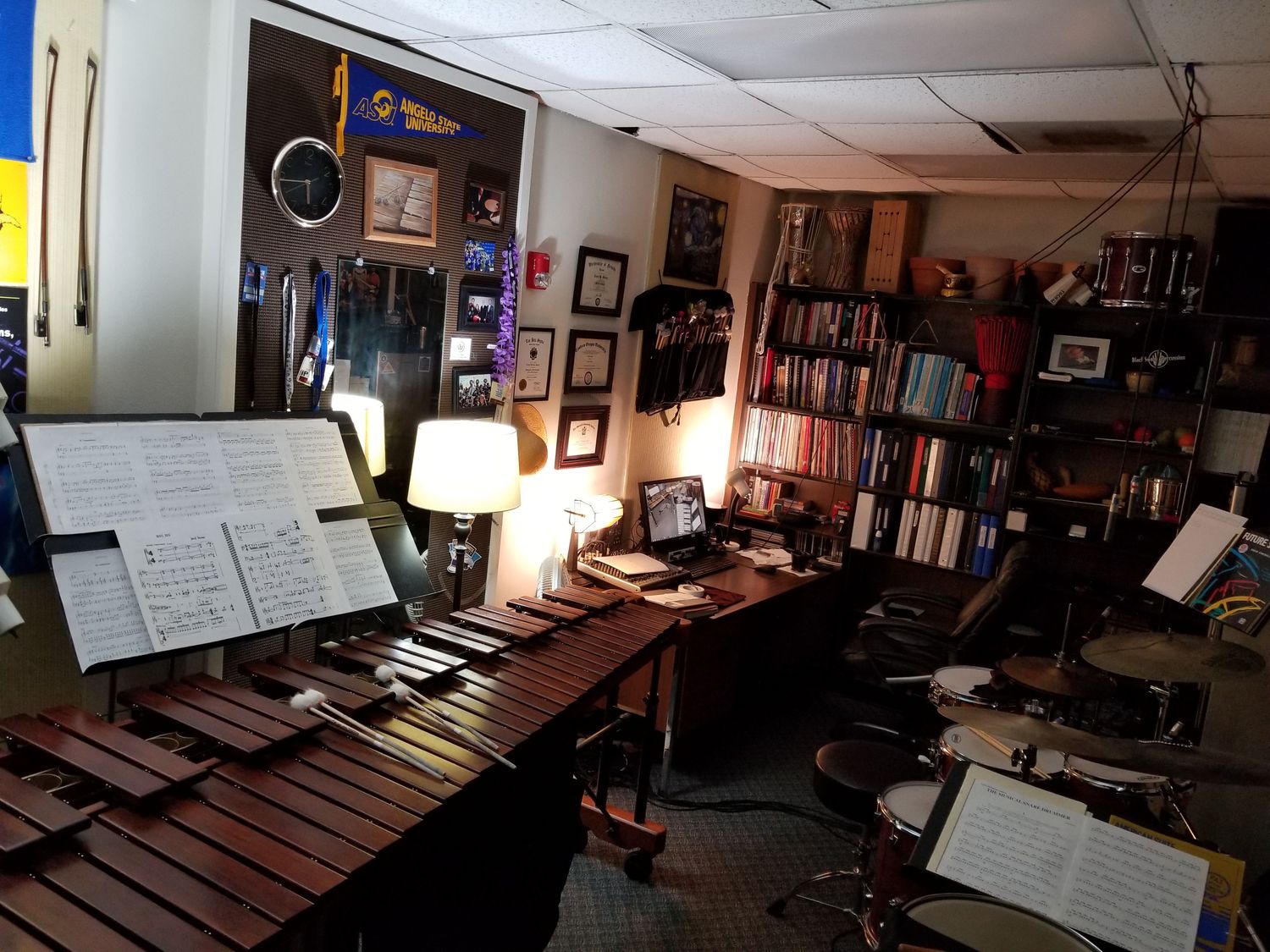
Room 288 is the main percussion room: the 5.0-octave Yamaha YM-5100 marimba, Musser vibraphone, four Ludwig timpani, the snare collection, drum sets, and storage.
Three further rooms hold a 4.3-octave Musser kelon marimba, a 4.0-octave Musser rosewood, and a xylophone. Room 134 is also available, with a full complement.
Sign up on the posted schedule for up to two hours a day. A reserved slot may be taken over if you are more than ten minutes late. Lights off, room empty.
You must pass the Skills Assessment Test before performing the Junior Recital (MUAP 3199) or Senior Recital (MUAP 4199). It is offered once per semester, during jury week.
You prepare everything; the panel selects. Every key, all forty rudiments, and all three instruments must be ready.
| Component | Drawn | To pass |
|---|---|---|
| Major keys | 4 drawn | All 4 must pass |
| Harmonic minor keys | 4 drawn | All 4 must pass |
| Rudiments | 4 drawn | All 4 must pass |
| Sight-reading | 3 readings | 2 of 3 must pass |
Scales at ♩ = 100, from memory. Rudiments from memory, eight times in succession without error. Sight-reading on snare drum, timpani, and two-mallet keyboard. Details in the handbook.
Student recitals are Wednesdays at 4:00 p.m. Sign up on the studio door.
Give notice by the night before if you cannot attend a lesson: email, text, or call. Missed lessons are made up at a time convenient to both of us.